
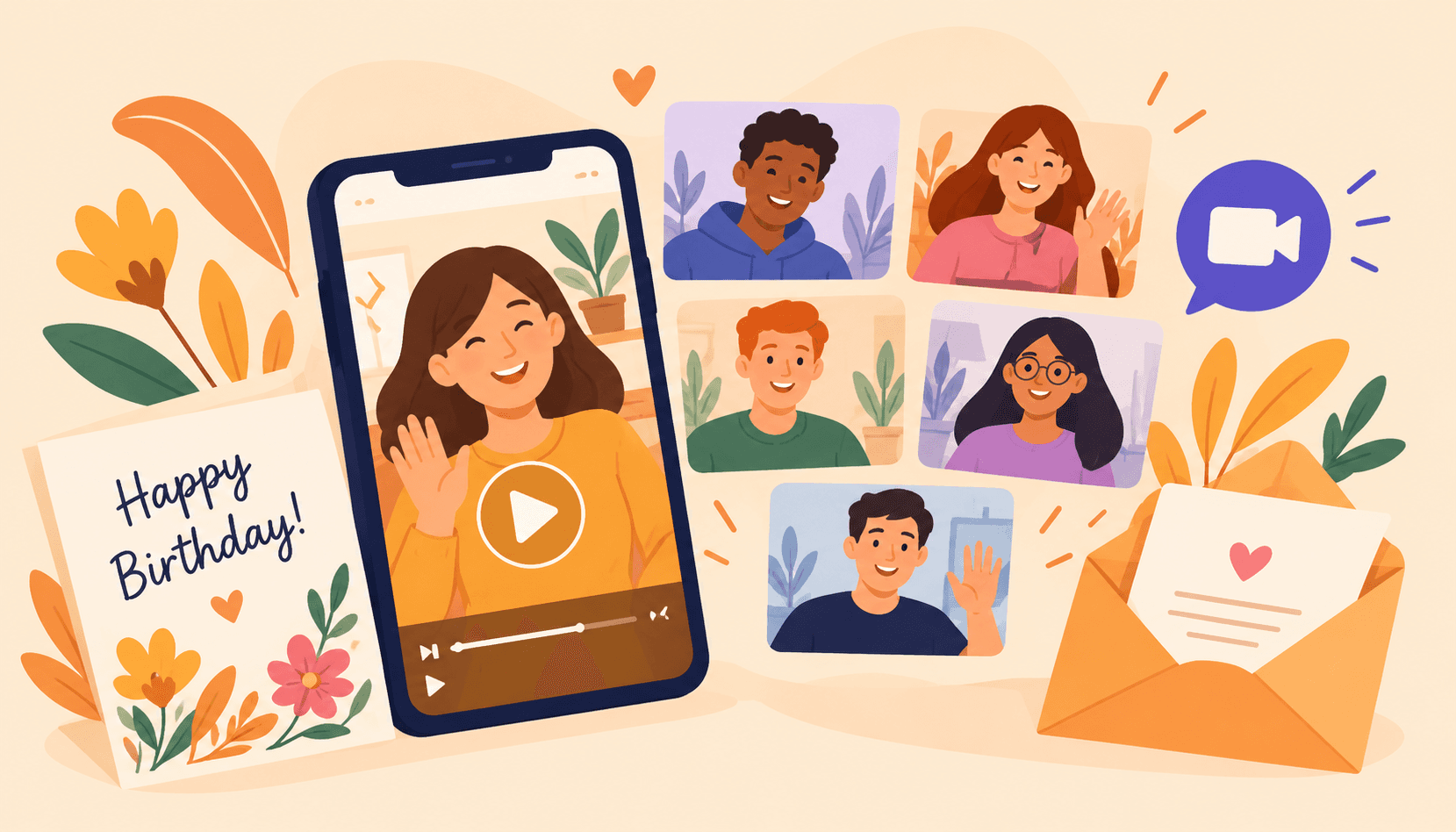
Recordable Greeting Cards: Why Personalized Video Messages Are Trending in the US
A birthday card used to mean picking one off a rack, signing your name, and hoping the printed sentiment said what you couldn't. That's changing. More people now want to hear a voice crack with laughter or see a friend's face light up on screen, not just read a line of cursive script. Recordable and video greeting cards are catching on because they combine everything a paper card gives you, a real moment set aside for someone, with the parts a card alone never could: tone, expression, and the sound of someone actually meaning it.
This shift shows up in everything from single voice recorder cards you find in a store to personalized video messages people record on their own phones. Here's what's driving it, what the different formats actually look like, and how group video cards fit into where things are headed.
What Is a Recordable Greeting Card?
"Recordable greeting card" covers more ground than it used to. A few versions are worth knowing.
Voice recordable physical cards are the classic push-button kind: open the card, a short audio clip plays, usually a recorded message or a snippet of music.
Video greeting cards skip the print entirely, or add to it. Someone records a video message on their phone or computer and sends it as a link or file.
Digital group video cards go a step further. Several people each record a short clip, and those clips get combined into one video, so the recipient gets a single card made of many voices instead of one.
Personalized multimedia greetings is the broader umbrella: any greeting that mixes text, photos, audio, or video into something built around one specific person and occasion, rather than a generic printed verse.
The thread connecting all of them is intent. A recordable card isn't trying to replace a written message. It's trying to carry more of the person sending it.
Why Are Recordable Greeting Cards Becoming Popular?
A few reasons keep coming up.
They carry more than text can. Tone of voice, a pause before someone says something sincere, a laugh in the middle of a sentence: none of that survives translation into ink. Hearing "happy birthday" said by someone who means it lands differently than reading it.
They capture personality. A recording keeps the small things: an accent, a nervous laugh, the way someone always says your name. Those details fade first in memory, and a video or voice message holds onto them.
They make group celebrations easier to pull off. Passing a physical card around an office, or waiting for every relative to sign something before it ships, takes coordination that rarely works out cleanly. A shared digital card sidesteps most of that.
They solve the distance problem. When people live in different cities, time zones, or countries, a recordable or video card lets everyone take part on their own schedule instead of needing to be in the same room.
They're easier to revisit. A paper card usually ends up in a drawer or the recycling bin. A video stays watchable for years, which is part of why people describe these cards as keepsakes rather than just greetings.
From Voice Messages to Group Video Cards
The format has moved fast. It started with one person recording one message, either on a physical card or a phone video sent straight to the recipient. The next step was collaborative: instead of one video, several people each contribute their own clip, and those clips get stitched into a single card.
For anyone trying to gather messages from an entire group, this solves a real coordination problem. Collecting individual video clips over text, email, and three different group chats is its own kind of chore, and someone always ends up chasing down the one cousin who forgot to send theirs. Platforms built specifically for group video greeting cards, like LovingEcards, handle that coordination directly. An organizer sets up the card and sends out one invite link, and contributors record or upload their clip right from their phone's browser, no app install needed. Everything comes back to one place, and the organizer combines the clips into a finished video montage before sending it on.
How Group Video Greeting Cards Work
The process tends to follow the same basic shape across most tools built for this.
- Pick a template. Most platforms offer themed designs for different occasions, which sets the tone before a single clip gets recorded.
- Set up the card. The organizer adds the recipient's name and any occasion details.
- Share the invite link. One link goes out over whatever channel the group already uses: text, email, Slack, WhatsApp.
- Contributors record or upload. Friends and family open the link on their own device and record a short clip, or upload one they already filmed.
- Arrange and trim. The organizer sorts the clips into an order that flows well, trimming anything too long.
- Add music or effects. A background track or a simple visual effect can tie everything together without overpowering the messages themselves.
- Send the finished card. The recipient gets one video, made up of everyone who wanted to be part of it.
None of this requires video editing skill. The organizer's main job is choosing what stays and what gets trimmed, not operating software.
When Should You Use a Group Video Greeting Card?
Almost any occasion where more than one person wants to say something works well as a group video card. A few where it tends to shine:
- Birthdays, especially milestone ones, where a video birthday card gives a lot of friends a chance to weigh in at once
- Retirements, where coworkers across departments or different years can each add their own memory
- Weddings, where well wishes from both families come together before the big day
- Graduations, where relatives who couldn't make the ceremony still get to celebrate
- Farewells, when someone is leaving a job, school, or city
- Baby showers, collecting excitement from people who can't attend in person
- Anniversaries, especially for couples whose friends are spread across different places
- Mother's Day and Father's Day, when siblings want to combine their messages into one gift
- Employee appreciation, recognizing someone's work across an entire team or company
- Long distance celebrations of any kind, where the whole point is making distance feel smaller
The common denominator isn't the occasion. It's that more than one person cares, and getting everyone's voice into a single card matters more than any of them sending something separately.
Recordable Greeting Cards vs. Traditional Greeting Cards
Traditional cards aren't going anywhere, but they do different work than a video or voice card. Laid out side by side, the difference is mostly about what a card can carry and who gets to be part of it.
| Feature | Traditional Card | Recordable / Video Card |
| Written message | Yes | Yes |
| Voice message | No | Yes |
| Video message | No | Yes |
| Multiple contributors | Limited | Yes |
| Remote participation | Limited | Yes |
| Rewatch or replay | Yes | Yes |
| Personalization | Medium | High |
A paper card still wins on a few fronts: something physical to hold, a spot to display it, no screen required. A recordable or video card wins on reach and depth. It can include people a paper card never would have, and it holds onto more of what they wanted to say.
Are Digital Greeting Cards Replacing Traditional Cards?
Not really, and it's worth resisting the urge to frame it that way. Paper cards still get bought in huge numbers, and plenty of people prefer a physical object they can prop on a shelf. What's actually happening is closer to expansion than replacement. Digital and recordable formats are adding options that paper never offered, not taking options away.
Someone planning a retirement party isn't choosing between a card and a video. They're often doing both: a physical card for the desk, and a video that fifteen former coworkers contributed to because half of them moved away years ago and couldn't have signed anything in person anyway. The two formats solve different problems, so it makes more sense to think of the greeting card as a category that's gotten bigger, not one format pushing another out.
How to Make a Memorable Group Video Greeting
A few things separate a video card that actually gets rewatched from one that gets opened once and forgotten.
- Keep individual messages short. Ten seconds of something genuine beats a minute of rambling.
- Record somewhere quiet. Background noise is the easiest thing to fix in advance and the hardest thing to fix afterward.
- Favor a specific memory over a generic wish. "I still can't believe you talked us into that road trip" beats "happy birthday" on its own.
- Mix up who goes first and last. Close family early, something lighthearted in the middle, and a strong closing message tend to hold attention better than clips sorted by whoever sent theirs first.
- Use music carefully. A soft track under the clips works. Anything loud enough to compete with people's voices defeats the point.
- Don't skip the people who can't be there. The relative overseas or the friend who moved away are often the messages that matter most, and this format is one of the few built to include them without anyone needing to travel.
The Future of Personalized Greeting Cards
The next stretch of this trend looks like convergence rather than any single breakthrough feature. Video and voice are already merging into the same tools. AI assisted editing is starting to help organizers trim and arrange clips without needing any editing background themselves. Interactive touches, like overlays or custom title cards between contributors, are becoming standard rather than a paid extra. Collaborative gifting, where a card is genuinely built by a group instead of one person, is starting to feel like the default rather than the exception.
What ties all of this together is the same thing that's always mattered about a greeting card: making sure a message actually feels like the person behind it. The formats keep changing, but that's still the part nobody wants to lose.
Ready to Bring Your Group Together?
If you've got a birthday, farewell, retirement, or any celebration coming up where more than one person wants to say something, a group video card is worth trying instead of chasing everyone down individually. Pick a template, send out one invite link, and let contributors record their clips right from their phones. No app required, and the whole thing comes together in minutes.
Start a free group video card on LovingEcards and turn everyone's messages into one video your recipient will actually want to watch again.
Ready to Create Your Own Digital Cards?
Create a beautiful group card or digital invitation in minutes. Share one link, and everyone can sign for free, no account needed.
Search
Recent Articles
Diwali Wishes for Colleagues, Clients and Boss: Professional Messages
October 24, 2026

Happy Halloween Wishes and Messages for Friends, Family and Coworkers
October 22, 2026
Happy Diwali Wishes and Messages for Family, Friends and Neighbors
October 22, 2026

5 Year Work Anniversary Messages (Plus 1 & 10 Year Wishes)
September 24, 2026

Happy Anniversary for Work: Messages & Wishes for Colleagues
September 23, 2026